What an Old Courthouse Square Can Still Tell You
Learn how to read an old courthouse square through its paths, buildings, and present uses, while keeping visible clues separate from proven history.
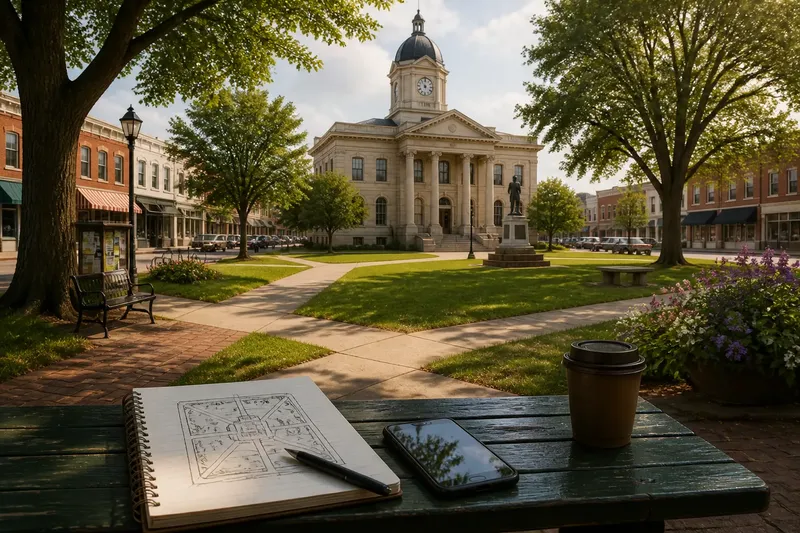
An old courthouse square can make a town’s history seem obvious: a courthouse in the middle, shops around the edge, and streets pointing inward. But an old courthouse square is a set of clues, not a caption. Read it over a morning, and you can see how the town is arranged, what people still use, and which historical claims need better evidence.
Why read the square over a morning?
A single glance favors the grandest building. A slower visit makes room for less theatrical evidence: a side entrance, a worn path across a lawn, a service alley, or a shop that opens onto the sidewalk rather than the square. None of these proves why the town developed as it did. Together, they help you ask sharper questions.
Plan the visit for a morning when the square is accessible and ordinary activity is under way. Bring a small notebook and a phone for photographs, and check posted rules before entering courthouse grounds or photographing people. You are looking at public space, not conducting an inspection. Keep to open sidewalks and paths.
Use three passes: first the ground plan, then the building edges, then the square in use. If you have only a short visit, spend more time on the first two and watch the last pass from a bench or public sidewalk.
What does the ground plan reveal?
Begin at a corner rather than beneath the courthouse steps. Walk the perimeter once, noting how streets meet the square and whether each side has the same width, shape, or access. A central building may sit neatly in the middle, or it may be offset, turned, or screened by trees. Record what you see without assigning a cause.
On a simple sketch, mark the courthouse, sidewalks, street crossings, entrances, public seating, and any open lawn. Note whether the corners provide direct routes across the square or send pedestrians around it. A diagonal path could reflect repeated use, a formal design choice, or later landscaping. The worn earth alone cannot tell you which.
Look for changes in level and boundaries. A low retaining wall, a fence, steps, or a row of trees can divide the space into areas with different degrees of access. Ask who can comfortably reach each entrance and where a person might wait without standing in traffic or blocking a doorway. These observations describe the square’s present arrangement, not its original purpose.
How do the surrounding buildings change the reading?
Turn from the courthouse to the buildings facing it. Note where doors and windows open, whether shop entrances face the square or a side street, and whether a building has a loading entrance or alley behind it. A row of storefronts may frame civic space while serving ordinary business. That coexistence is more informative than treating the square as a stage set built only for ceremonies.
Compare rooflines, materials, and storefronts, but resist dating them by appearance alone. Brick, painted wood, metal awnings, and replacement windows can belong to different periods of repair and adaptation. A building’s current face may preserve an earlier outline while concealing later changes. Describe the materials and differences you can see; leave the date for records to establish.
Watch how the courthouse relates to its neighbors. Is its entrance visible from the main approach? Do nearby doors face toward it, away from it, or both? Imagine you arrive on foot to collect a parcel from a shop and then need to cross to the courthouse. If a sidewalk connects those doors directly and a curb ramp serves the crossing, you can observe a usable route; you still cannot infer that the route was designed for that errand or has always been accessible.
What can present-day use tell you?
Pause in a permitted public spot and notice what people do, not who they are. People may cross, sit, wait, attend to business, or pass through without stopping. A farmers’ market sign, a public notice board, or a bench used as a meeting point can show how the square functions now. One quiet morning does not establish that the space is usually quiet.
Look for the practical arrangements behind public life: shade, benches, accessible paths, trash receptacles, lighting, and places to park a bicycle. Record their locations and whether they serve the whole square or only one edge. These details can reveal who is accommodated by the present design, but not what earlier residents thought or intended.
Say you find a broad path crossing the lawn, a bench under a large tree, and a notice for an evening meeting. Write down those three observations, then keep the interpretations separate: the path is worn, the bench provides shade, and the notice indicates a planned gathering. You may reasonably ask whether the crossing is a common route, but you would need more than that morning’s visit to answer.
What questions should you ask after the walk?
Does the courthouse’s central position prove the square was always planned this way?
No. A building’s position describes the arrangement you can see today, not the sequence of changes that produced it. Use town maps, property records, or local historical collections to check how the layout changed.
Can a worn path identify an old route?
It can identify a route people use now, but wear does not establish its age. Compare the path with older maps or photographs before calling it historic.
Do similar-looking storefronts belong to the same period?
Not necessarily. Matching materials or façades may reflect later renovation, a shared style, or simple maintenance choices. Treat visible similarities as a reason to investigate, not a date.
Where can I check a claim about a square’s history?
Try a local library, county records office, preservation group, or historical society. Ask for maps, photographs, deeds, or documented building histories that address the specific feature you noticed.
How should you finish the morning?
Before leaving, revisit your sketch and mark which notes are direct observations and which are questions. “Two sidewalks meet at the northwest corner” is an observation. “The corner was the original entrance to town” is a claim that needs evidence. Keeping the two apart makes the next visit more useful.
For a small follow-up, choose one feature rather than researching the entire town. A local archive may hold a map that clarifies a street alignment; a preservation office may have a building survey; a public records desk may explain where property documents are held. Ask about the feature and the record that could establish its history. A visual detail is a good starting point, not a substitute for documentation.
An old courthouse square still tells you how space is arranged and used in front of you. The main phrase, “old courthouse square,” names the place, not a conclusion. Leave with a careful sketch, a few concrete questions, and enough restraint to let the records supply what the pavement cannot.