The Recipe That Never Stayed the Same
Southern recipes change with ingredients, household habits, and retellings. Learn how to compare versions without mistaking one family’s method for the only original.
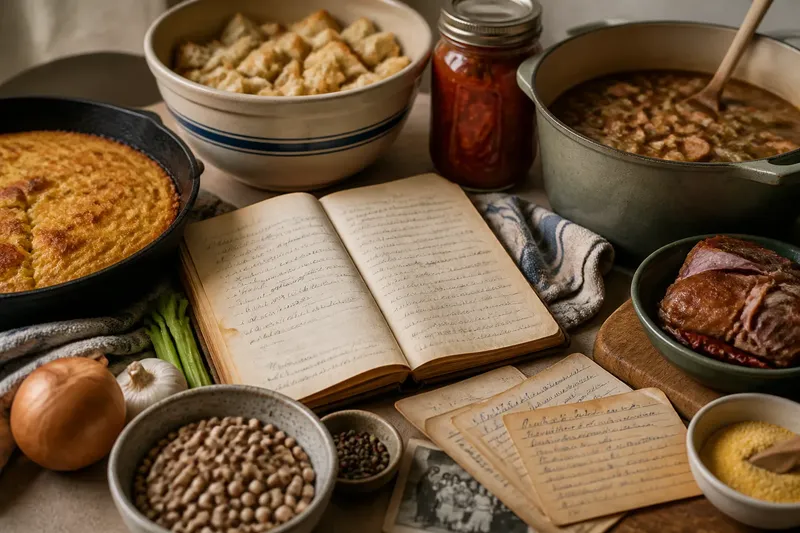
Southern recipes rarely arrive with a single, settled original. A cornbread dressing, gumbo, or pot of beans can change as ingredients shift, household routines adapt, and someone tells the story again. If you are trying to understand a regional dish, the useful question is not which version is authentic, but what each version reveals about the people who made it.
There are three sensible ways to read a recipe’s history: compare its ingredients, follow the habits around its preparation, or listen to how people retell its origins. Each offers a different kind of evidence. None can settle every argument, which is fortunate for anyone who has eaten at a holiday table.
What can ingredients tell you about a Southern recipe?
Ingredients make change visible. A recipe may list fresh tomatoes in one household and canned tomatoes in another, or call for butter where a neighboring cook uses lard. Those differences can reflect what was available, affordable, familiar, or suitable for the job—not a simple contest between the original and the corrupted.
Read the ingredient list as a record of choices rather than a verdict. Consider what each ingredient does. Cornmeal gives a dish body; buttermilk brings tang and moisture; a smoked ham hock contributes salt and flavor. If one item changes, the result may change too, but the dish can still belong to the same family of food.
Availability matters, though it is only part of the story. A household might use dried peas because they keep well, fresh field peas when the garden provides them, or canned peas because that is what the cook prefers. These are not necessarily stages in a tidy march from old-fashioned to modern. They can be parallel habits, each shaped by a different kitchen.
Substitution also carries memory. Someone may use a particular brand of hot sauce because it was always on the table at home. Another cook may choose sorghum where a relative used molasses. A recipe card rarely explains such choices; it records the ingredient, not the conversation that made it seem obvious.
When comparing written recipes, note both what appears and what is absent. One version may specify a particular cut of meat, while another leaves the choice open. One may list a spice that the other relies on the cook to recognize. That silence can indicate familiarity, not a missing piece of history. Recipes often assume a kitchen’s shared knowledge.
This approach suits readers who have several written versions and want to understand how they differ. It is less useful when the central question is why a family makes the dish for a particular occasion. Ingredients can show what went into the pot; they cannot, by themselves, explain who gathered around it.
How do household habits reshape a dish?
A recipe is not only a list. It is also a sequence of household decisions: what gets prepared ahead, which pan is used, who watches the stove, and what counts as done. These habits often travel by observation rather than written instruction. A cook learns the texture to look for, the sound of a simmer, or the moment to stop stirring.
That knowledge helps explain why two people following the same written recipe can produce different results. One household may make a dish thick enough to slice; another may serve it soft with a spoon. A family may cook a large pot for a gathering and a smaller, less elaborate version on an ordinary evening. The occasion changes the method without necessarily changing the name.
Household routines can also preserve a recipe while altering its details. A cook who has limited time might prepare part of a dish the night before. Someone cooking for a relative who avoids a particular ingredient may set aside a portion before adding it. Such decisions are not side notes to food history. They are how a dish remains usable in actual kitchens.
Say you inherit two handwritten recipes for the same family’s cornbread dressing. One calls for torn bread and sage; the other gives no measurements and says only to add broth until the mixture feels right. You could compare the ingredient lists, but asking who made each version and when may explain more: one may have been written for a large holiday meal, the other copied as a reminder for an everyday cook. The observable difference is not just what enters the bowl, but how much guidance the cook needs.
This approach suits anyone with access to family stories, kitchen notes, or a person who still makes the dish. Ask what happens before cooking begins, what the cook watches for, and what can be changed without complaint. Keep the questions open. “Why do you do it that way?” invites a history; “Is that the right way?” tends to invite a defense.
Household habits can be hard to document because cooks may treat them as too ordinary to mention. A note such as “until it looks right” can frustrate a new cook, but it is also a clue: the original instruction was probably demonstration, not prose. It tells you that the recipe once depended on a shared kitchen and an experienced eye.
Why do recipes acquire competing origin stories?
Retellings give dishes meaning, but they can simplify what happened. A family may remember that a dish came from one relative, one town, or one memorable gathering. Another branch of the family may tell a different story. Both accounts can preserve real connections while leaving out the ordinary borrowing and improvisation that helped the dish take shape.
Food stories are often organized around a memorable person: the aunt who brought the casserole, the neighbor who shared a starter, or the grandparent who insisted on a certain seasoning. That person may have been the family’s most visible cook, not the sole inventor. Recipes move through friendships, work, migration, church suppers, and everyday exchanges. A name attached to a dish can mark a strong association rather than exclusive authorship.
Retelling can also tidy up a dish’s identity. A narrator may describe one version as the family recipe, even though the family has several. That shorthand is useful at the table. It becomes less reliable when treated as proof that every earlier cook followed the same method.
When hearing an origin story, notice what it explains and what it leaves open. Does it identify who made the dish, who taught it to whom, or simply where someone remembers eating it? Does a second account contradict the first, or add another branch of the story? A difference in memory need not make either person dishonest. People often remember the version that mattered to them.
This approach suits readers interested in community memory and family identity. It is especially helpful when written evidence is sparse, but it calls for care: a vivid story is not the same thing as a complete record. Treat it as testimony about relationships and recollection, not as a final ruling on ownership.
Which way of reading a recipe should you choose?
Choose according to the question you actually have. If you want to know how a dish’s flavor and texture changed, compare ingredients. If you want to understand why a cook works without measurements, follow household habits. If you want to understand why a dish matters to a family or place, listen to its retellings. For a fuller picture, put the three approaches beside one another rather than forcing them to agree.
- Use ingredient comparison when you have multiple cards, cookbooks, or versions from different households.
- Ask about routine when the written instructions are vague or the method seems more important than the ingredient list.
- Listen for retellings when people connect the dish to a relative, community, or occasion.
- Keep versions distinct when recording what different cooks make; do not silently merge them into a single supposedly definitive recipe.
- Record uncertainty plainly when nobody remembers a detail. “Family recollection differs” is more useful than an invented certainty.
These choices are not competing standards for authenticity. They are different ways to notice change. A recipe can be recognizable because its name, purpose, or core method persists, even as a seasoning shifts or a cook adapts the preparation. Conversely, two dishes can share a name while carrying different meanings in separate households.
What do readers usually ask about changing recipes?
Can a recipe be authentic if the ingredients changed?
Yes, if “authentic” describes a version genuinely made within a household or community rather than an imagined untouched original. Ingredient changes may reflect preference, availability, or a cook’s practical needs.
How can I tell which version came first?
Look for dated written records and ask who copied or used them, but expect gaps. A family’s oldest surviving card proves that the card existed by then, not that the dish began there.
Should I combine two family recipes into one?
Only if your goal is to make a new working version. Keep copies or notes on the originals first, so the differences and the people associated with them do not disappear into a convenient blend.
What should I do when relatives disagree about a dish’s origin?
Record each account with its teller and the details they remember. You can preserve the disagreement without deciding that one person must be wrong.
The recipe that never stayed the same is often not a failed original but a record of people adjusting food to their kitchens and passing it along. If you are writing down a Southern recipe, keep the cook’s name, the occasion, and the small choices that make the method theirs. Those details are what let a future reader see not just what went into the dish, but how it came to belong somewhere.